
INTRODUCTION
By now, it should be clear that the Earth is heating up, but then … maybe not. You might not be as comfortable with that claim as I am. Many who pick up this book will be less convinced that the Earth is experiencing human-induced climate change as I am, and the mandate “extraordinary claims require extraordinary evidence” applies as much to me as to everybody else.
According to NASA, 2024 was the hottest year in recorded history. Moreover, NASA claims even more heat records were broken in 2025:
- warmest ocean heat content on record,
- record high sea levels,
- and lowest winter Arctic ice … since satellite monitoring began.
These are extraordinary claims, and such claims need extraordinary proof. Well, here is the topmost layer of their proof – a graph showing the average temperature of the Earth for every year since 1880.
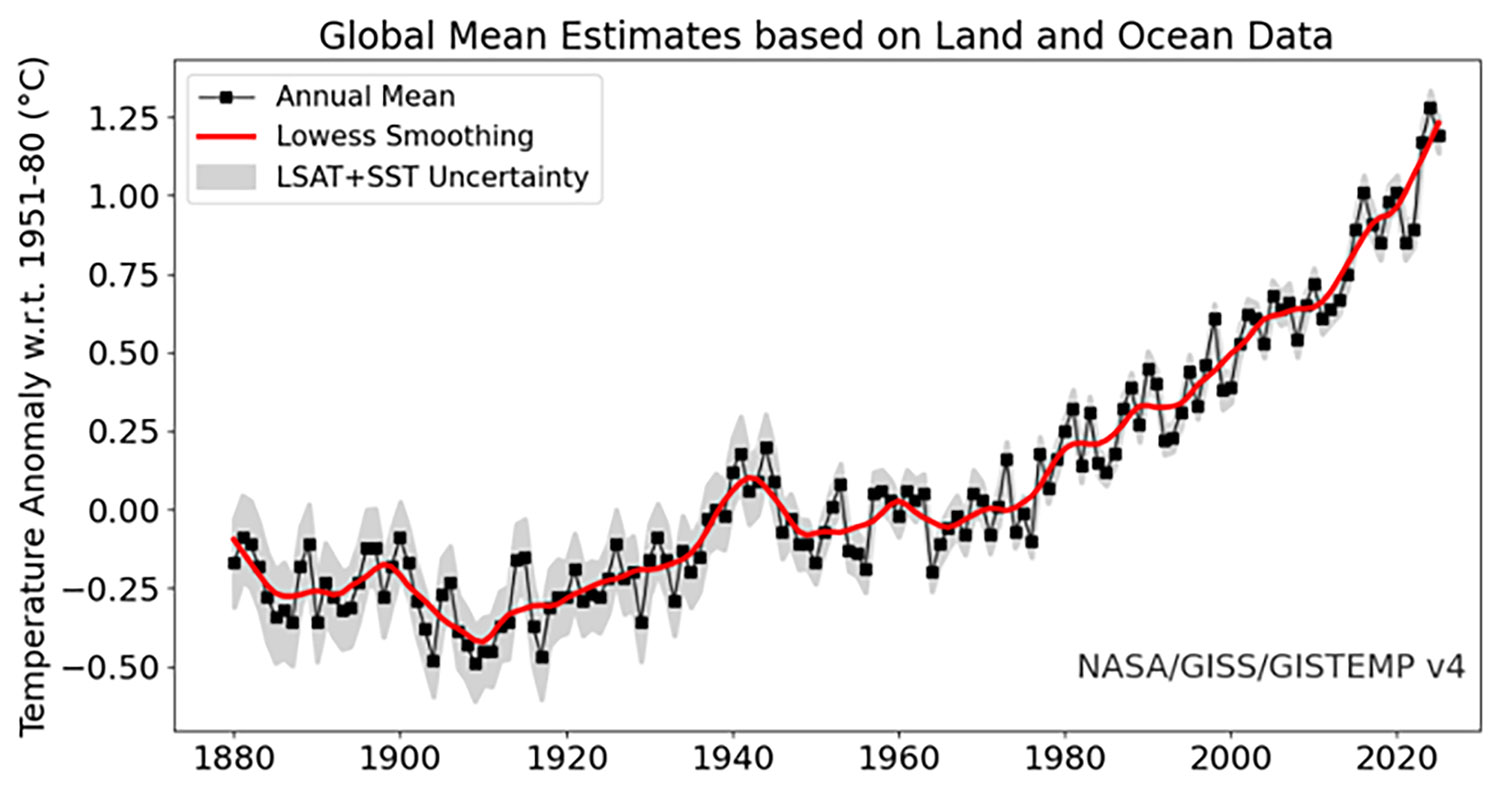
Figure 1: graph showing average annual temperatures between 1880 and 2025.
First, I should point out that this data isn’t just from the United States scientific organizations. Many organizations around the world are taking these measurements at hundreds of thousands of points in the Arctic, Antarctic, and all the world in between. Their measurements come from ground-based weather stations as well as ships and buoys at sea. Moreover, NASA weather satellites verify the numbers, so, in effect, the temperatures of all those places are taken twice and those numbers compared. The National Oceanic and Atmospheric Administration (NOAA) collects the data, and NASA verifies it. In the end, there can be little doubt that the numbers are valid.
This evidence is pretty compelling. It shows 55 years of uninterrupted climbing temperatures, and 107 years if we include the 1942 interruption. Still, as persuasive as the chart might be, how do we know where they got the numbers they used to make the chart? Should we not see that evidence?
- How is it possible to measure the temperature of the whole world and get an accurate average temperature, and have all of those millions of measurements be reduced to one number that represents the average temperature of the Earth for a given year?
- And how does anyone measure the Earth for a hundred and seventy-four years so accurately that they can confidently say “the Earth has warmed by 1.6ºC, on average, over that whole period?
- So what if the Earth has warmed 1.6ºC in the past 174 years? The temperature of the Earth warms or cools more than 1.6ºC during most any hour of any day.
One of NASA’s answers is …
Climate scientists focus on how the temperature has changed over time. For each individual station, they calculate how the temperature has strayed from an original baseline; these are known as anomalies. The baseline used is the temperature average from the 30-year period 1951—1980. Every location is measured against that 20th-century average. [1] This How Scientists Measure Global Temperature - NASA Science
Well … that answer is about as clear as mud to me and probably to you, but perhaps with some research, I can produce a more understandable answer.
How do we know scientific measurements of the Earth’s temperatures are accurate?
First, I should point out that this data isn’t just from the United States scientific organizations. Many organizations around the world are taking these measurements at hundreds of thousands of points in the Arctic, Antarctic, and all the world in between. Their measurements come from ground-based weather stations as well as ships and buoys at sea. Moreover, NASA weather satellites verify the numbers, so, in effect, the temperatures of all those places are taken twice and those numbers compared. The National Oceanic and Atmospheric Administration (NOAA) collects the data, and NASA verifies it. In the end, there can be little doubt that the numbers are valid.
But to what extent can we trust the process of converting millions of daily measurements into a single, meaningful average temperature for the Earth over a year?
Understanding the terms
Baseline: NASA mentions “baseline” above but doesn't explain it, so I will. To understand how temperatures change over time, research organizations such as NASA, NOAA, Berkeley Earth, and others need to compare current temperatures to meaningful historical data (a baseline). To maximize accuracy, researchers use the averages of segments of time that are historically stable (some of these are 1850 to 1900, 1951 to 1980, 1981 to 2000). Because there are a number of agencies and time periods of interest, the agencies use different baselines for different purposes. The baseline NOAA uses is 1980 to 2000 to show recent changes, while NASA uses 1951 to 1980. In every case, each baseline is set to 0.00ºC. All temperatures collected, their relative positions are compared to those specific baselines.
Anomaly: A temperature above or below the baseline is called an “anomaly.” Anomalies are noted as -0.NºC for temperatures below the baseline and +0.NºC for temperatures above the baseline (N being the temperature’s actual number). Obviously, temperatures vacillate from year to year. Under normal circumstances, average temperatures would vacillate above and below the baseline for centuries, but if the lowest temperatures keep rising higher above newer and higher baselines indefinitely, the only assumption we can make is that the climate is growing warmer. In the case of NOAA’s 1981-2000 baseline in the chart below, the warmest average temperature passed above the baseline for the first time around ~1979 and the coolest average temperature passed above the baseline for the last time in ~1999. The anomalies passed through the baseline in around 20 years, and they never returned.
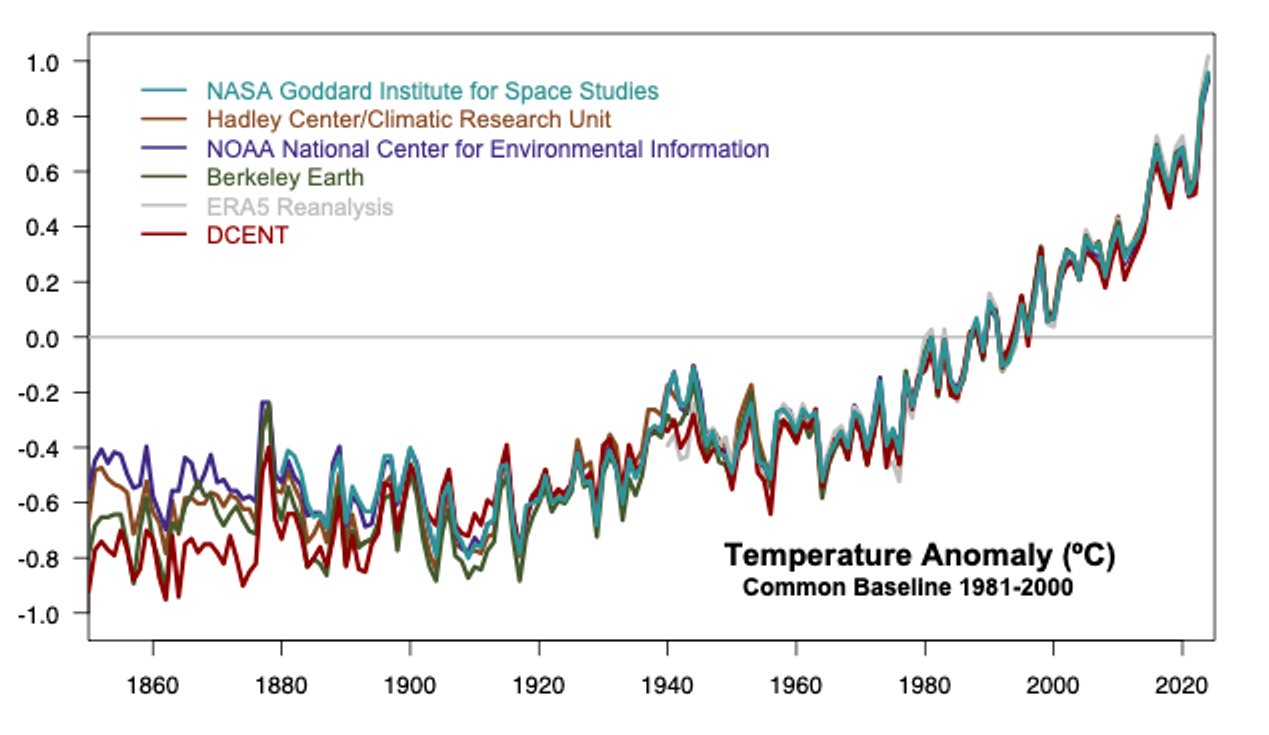
Figure 2: Chart produced by NASA to show the commonality of results from a variety of research institutes. In this case, the chart shows the trends of climatic evolution since 1850 (the beginning of the Industrial Revolution
In the graph above, we can see the paths mapped by six different agencies around the world. The early years of the mapping reveal some contradictions between the agencies, but by around 1965, they converge as sample numbers increase and readings become more accurate. In the end, all agencies clearly show the average climate temperature of the Earth to be dramatically climbing.
The math behind the chart is effectively a spreadsheet.
The averages in the graphs above seem compelling, but how do the researchers find those averages? If global temperatures rise above that baseline and continue to rise, the conclusion must be that the Earth is warming, and their math says the Earth's temperature has been rising since about 1965 (or 1890). So, “Are their calculations valid?”
Here is NOAA’s math in detail:
First, their math for handling these numbers is not calculus or even advanced algebra. Their math is largely done in spreadsheet environments. With enough time and computing power, you could do this at home using Excel.
There are tens of thousands of weather stations around the world — on land, on ships, on buoys, and in polar regions. These stations report temperatures to their national meteorological agencies, which then share the data with global systems such as NOAA, NASA, and the World Meteorological Organization.
Weather stations measure daily temperatures, often reporting the day’s maximum (Tmax) and minimum (Tmin). Many modern stations also report hourly temperatures. Daily means are calculated either as the average of Tmax and Tmin or as the average of all hourly readings.
National agencies collect and quality check the data, then send it to global archives such as NOAA’s Global Historical Climatology Network (GHCN) and the International Comprehensive Ocean–Atmosphere Data Set (ICOADS).
NOAA does not simply average all station temperatures. Instead, it homogenizes the data (correcting for station moves and instrument changes), interpolates it onto a global grid, and computes an area weighted global monthly temperature anomaly.
NOAA compares each month’s global temperature to a baseline period, producing a monthly anomaly. This is repeated for seasons and years.
NASA does not receive NOAA’s averages. Instead, NASA independently downloads the same raw station data and applies its own methods to produce the GISTEMP dataset. The two agencies’ results are extremely similar because they use the same underlying observations.
All datasets are continually updated as new or corrected observations arrive, improving accuracy over time.
Although the processing involves millions of observations and sophisticated quality control steps, the underlying mathematics — averaging, subtracting, and weighting — is conceptually simple and could be reproduced in a spreadsheet on a much smaller scale.
What the results look like
The graph in Figure 2 shows a series of clear trends. I pointed them out earlier but didn’t explain what was causing the changes. For example, I mentioned that from 1850 until ~1919, global temperatures drifted slowly downward. That downward trend is because, having come out of the last ice age, we have been moving toward the next one for about three thousand years. The takeaway from this is that temperatures have been going down for thousands of years and should still be going down.
After 1919, the trend turned upward and continued rising until about 1945. As the Industrial Revolution ramped up, CO2 began overwhelming our drift towards our next ice age, and temperatures began to rise.
Between 1945 and the late 1970s, the warming trend stalled. This 1945 plateau was caused largely by heavy post war air pollution (especially sulfate aerosols) that reflected sunlight back into space and temporarily masked the warming trend, caused greenhouse gases. Once clean air laws began reducing aerosol pollution in the 1970s, the underlying warming trend re emerged, and temperatures resumed their steady climb. They have been climbing ever since.
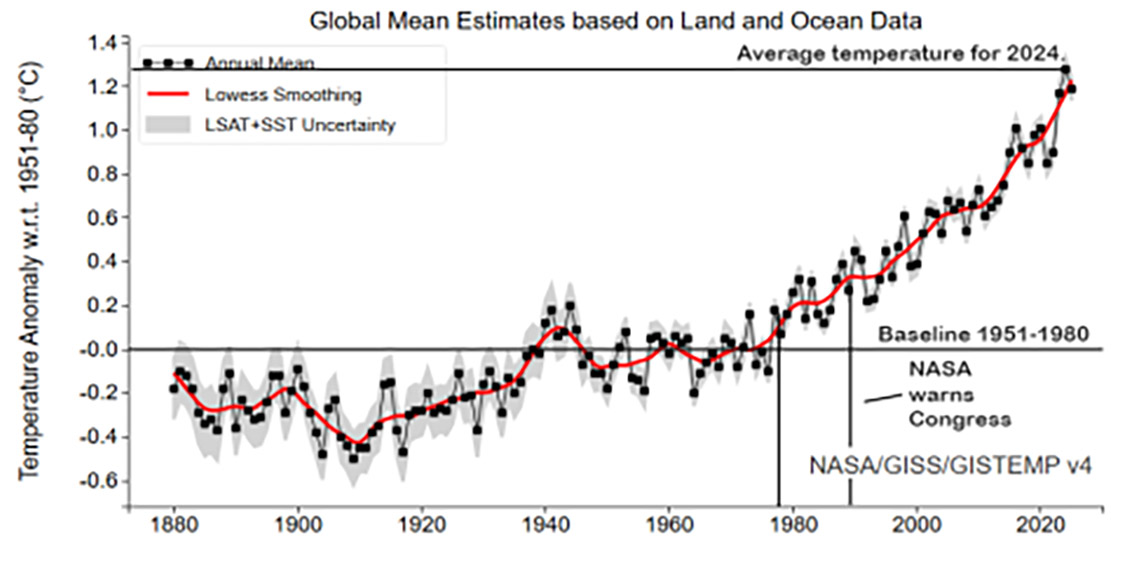
Figure 3: This chart was put together by NASA. The 1951-1980 baseline shows where the climate trajectory changed from uncertain to clear. ~1977 was the last time the average temperature fell below that baseline. In 1988, after tracking rising temperatures for ten years, NASA warned Congress that the temperature was definitely rising. In 2024, NASA warned Congress that the Earth had reached 1.5ºC, and we are blowing by it like a long-distance driver passing a mile marker on the freeway. (Well, they didn’t actually say that last part – that’s me. I added added the baseline tag and the lines indicating the last time the lowest average temperature and the line marking when NASA notified the U.S. Congress the climate was changing.
The baseline represents the average temperature for the years 1951 through 1980. As we have already noted, around 1977, the average temperature punched through the baseline for the last time. Once it passes through, there is plenty of reason to believe that it will fall back through the baseline at some point in the future. NASA watched the temperature climb for around ten years, then warned the United States Congress that it is tracking evidence of global warming.
How long have NASA and others been giving the U.S. public the bad news?
James Hansen, then Director of NASA’s Goddard Institute for Space Studies, testified before the U.S. Senate that global warming had begun. His testimony wasn’t speculation, and it wasn’t a warning about some distant future. It was a statement of fact; in 1988, global warming was already in progress.
In brief, we, the public, were told in 1988 that our climate was already becoming hotter. So, the answer to the question above is “We have known the climate was already changing for 36 years.”
Academic Researchers Came to the Same Conclusions.
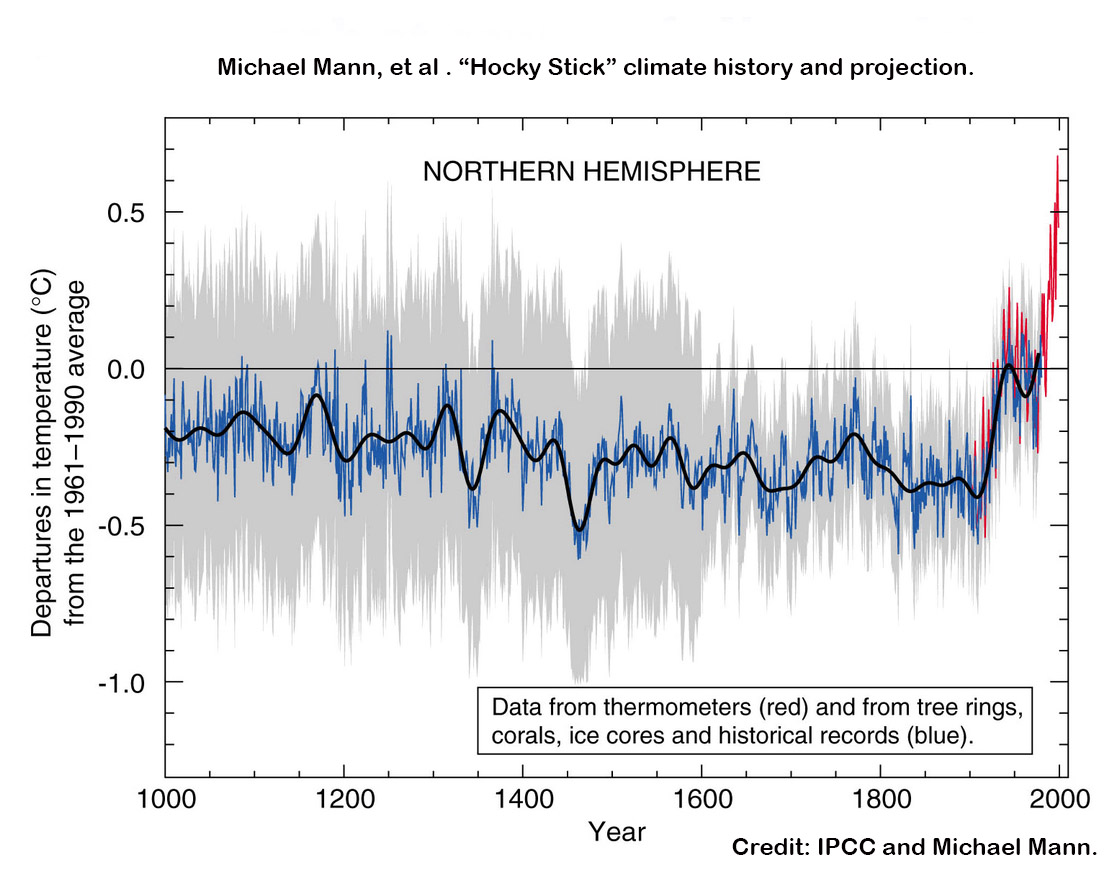
Figure 4: Results of a study of a thousand years of temperatures on Earth. The chart shows the same behavior as the NASA chart, but over a much longer period, so the swings are more foreshortened.
The first 600 years of their chart are controversial because there were no accurate thermometers before 1665. Mann (et al.) used proxies to imply temperatures before 1660 (e.g., tree rings, ice layers in glaciers, mud layers in lake beds).
Using proxies for identifying past climate conditions.
Obviously, any temperatures claimed for the period before 1656 are somewhat speculative, but it is possible to make reasonable inferences. Temperatures before the invention of thermometers are not measured directly, but they’re not guesses either. Scientists use proxies, which are natural records that respond to climate in measurable ways. Tree rings, lake sediments, glacial ice layers, corals, and historical documents all contain signals that reflect environmental conditions of the time.
Tree rings make a good example. In years that are warm and wet, many trees grow wider, denser rings, while in cold or dry years, the rings are narrower or have different densities. During the modern period (when we have both tree ring data and thermometer records), we can see exactly how a tree responds to known temperatures. Identifying those tendencies in proxies permits us to create a calibrated scale. Once calibrated, the same patterns in older rings and newer rings can be interpreted as evidence of comparable climate conditions in the different samples.
Glacial ice layers work the same way in principle, but through different physical signals. Each layer of ice represents a year. The layer will have trapped tiny bubbles of ancient air and will contain specific ratios of oxygen, hydrogen, and other isotopes. Those isotopes shift in predictable ways with temperature. They can also pinpoint times of events (e.g., volcanic eruptions) by finding gases identifiable as volcanic. By calibrating isotope ratios against modern measurements, scientists can infer climate conditions for periods occurring long before instruments existed.
This is why reconstructions before 1656 are not speculative guesses. They are inferences grounded in calibrated physical relationships between the modern climate and climates of the distant past. Still, the farther back in time we look, the more uncertainty we will find, so researchers add a field of uncertainty (the gray areas in the chart) to allow readers to see the level of scientific certainty.
The fossil fuel industry hated the chart.
At the time the article containing the chart was published, it was the most damning evidence of global warming to date. The evidence horrified the oil industry, and they (and their supporters) attacked the chart with all the vehemence they could muster. During the peak of these climate denial attacks, extremists even published the names of Mann’s children and the schools they attended. Although no harm came to them, the bullying of the children and death threats directed at the family ultimately forced them to move to a new, undisclosed location, underscoring the lengths to which opponents of climate science were willing to go to protect the oil industry.
Critics claimed that using proxies is unscientific. Using proxies, however, isn’t as flaky as it sounds. If we consider that trees more than a thousand years old have been used for dating ancient structures for more than a hundred years, it is reasonable to accept these proxies as a valid model for the past, but this is done with the understanding that proxies are imperfect tools. They give us approximations and not specifics.
The proxies gave them a great deal of information, but Mann and his team recognized that the proxies didn’t provide sharply focused information. They showed their level of confidence (or lack of confidence) in the early numbers by using gray areas (see them in the chart below). But their numbers after 1600 are less vague. What the numbers after 1600 show is a slow downward drift for 400 years. But beginning around 1850, the temperatures began to spike, and after around 1880 (once the average temperature of the Earth was established), their numbers skyrocketed.
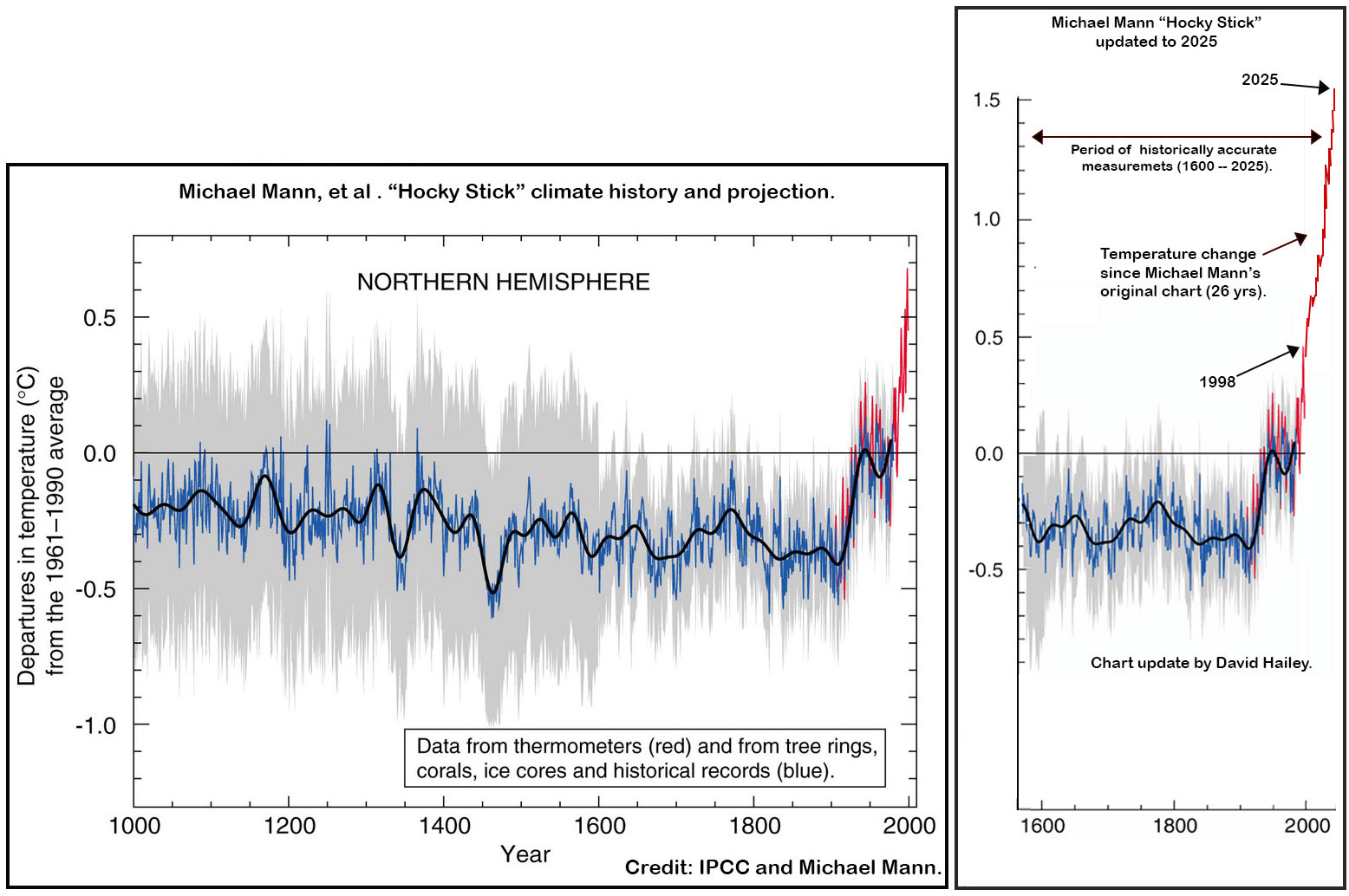
Figure 5: The chart at the left, above, was produced by Michael Mann and his associates in 1998. The chart displays a sudden rise in the average temperature of the Earth starting at the beginning of the Industrial Age. In the chart to the right, above, I updated their chart from 1998 to 2025. The change in 27 years is almost 400%.
Their chart, however, ends in 1998 and so is not up to date. I took the liberty of updating it using NASA’s information (my chart is on the right). I only used the last 299 years of the Mann chart because that is the timeline after the invention of the thermometer. There is nothing left in this chart for the climate change deniers to cling to.
As I said earlier, their chart is called the “Hockey Stick” chart because it looks somewhat like a hockey stick lying on its back. My version of their chart looks more like a hockey stick leaning against a wall. I also mentioned earlier that we are in a slow-motion explosion, but we couldn’t see it because it was occurring in geological time. In my chart, you can see what the explosion looks like in a geological timeframe.
The explosion looks out of control, but it is not – at least not yet. If we stopped producing CO2 today, the explosion would run out of fuel and stop.
The future looks bad, but it’s not.
This is where a normal book would give you all of the bad news and maybe make you feel bad for having done so little to curb climate change. Well, I am not going to do that, because the news is not so bad, and if in the past you tried to do your part in curbing climate change, you will already know there was not much you could do.
Why weren’t we buying EVs?
In the 1890s, if someone took a drive from Baltimore to Washington, D.C., it was not a road trip; it was an adventure. In 1890, you bought gasoline in quart jars at apothecaries and hardware stores, and cars had dismal gas mileage. Before 2026, driving an EV cross-country was a similar experience. EVs were expensive, and there weren’t enough places to charge them.
Worse, a bunch of absolutely nutty conspiracy theorists were so desperate to prove they were right that they made an ongoing practice of vandalizing charging stations. You never knew when you got to a charging station if it would work. There was this thing called “range anxiety,” but people said “range anxiety” because it was harder to say than “terrified that when I get there, I will find all the chargers broken.”
So, we bought hybrid EVs by the boatload! It seemed like all of our liberal neighbors were driving hybrids. The truth is that there are many more of these cars on the road than we realize. Because they look like all the other cars, we don’t usually notice that they are hybrids as they go by.
On the other hand, we are at the beginning of a critical path into the future. All of those things I said in the previous paragraphs are no longer true. There are 83,000 charging stations in the U.S. today, and there will be twice that number in the near future. Range anxiety is a thing of the past. My new EV cost $28K. We are moving toward an amazing future of wonderful possibilities.
The truth is this: there is not much we could have done to curb climate change.
Frankley, in the past, there have been few good paths to a sustainable future. But now there are new paths opening up. In many of them, you can actually see where the path will take you, even as you step onto it. In this book, I will guide you to those paths and show what their destinations will look like. If we do everything right, the new future will be like comparing today to the beginning of the industrial age. My goal in this book is to introduce you to the world your children and their children will live in, if we get it right.
And this introduces one vision of our future.
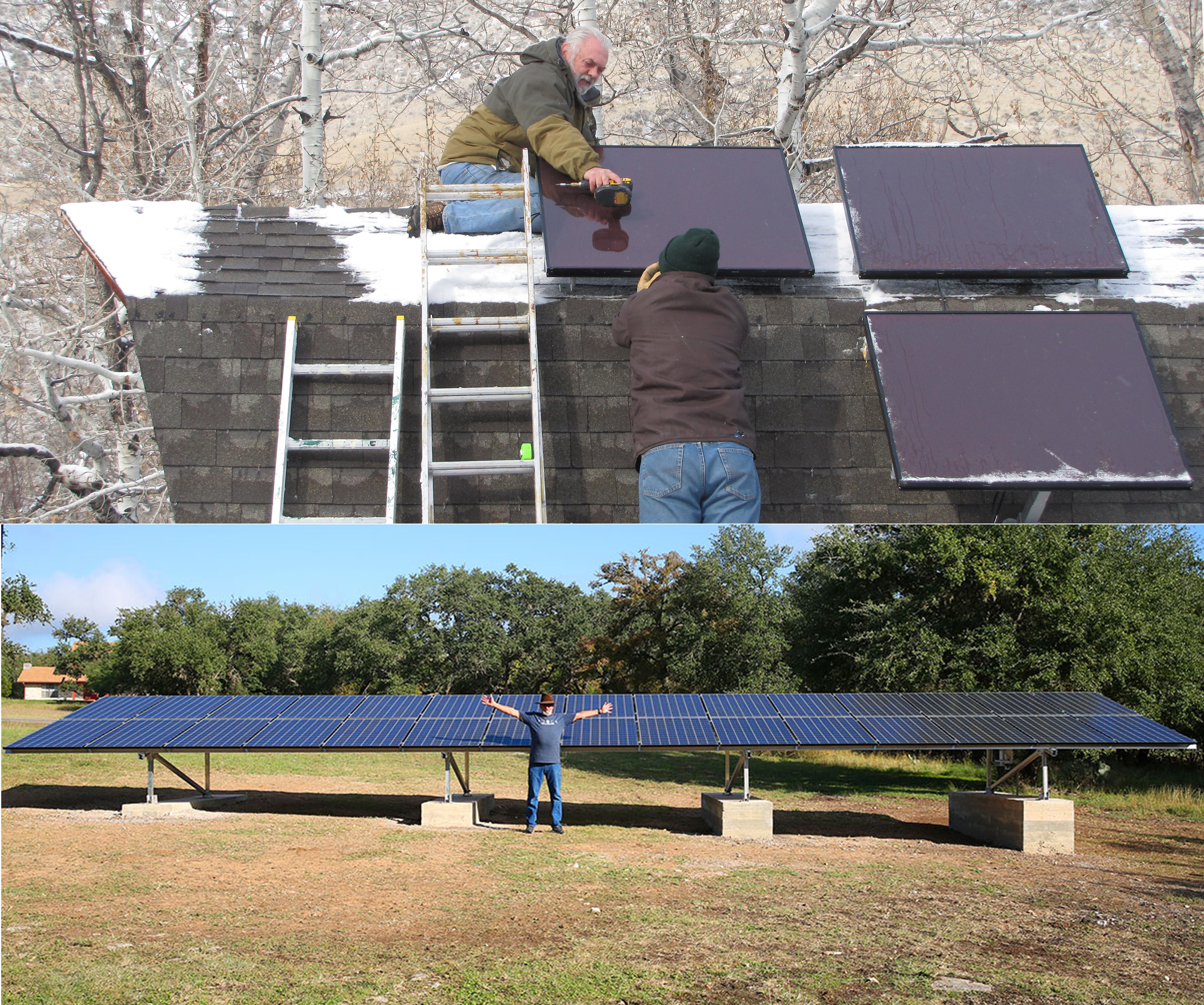
Figure 6: The difference in cost over 20 years. The six panels at the top were 66Wh and cost around $18,000 plus another $2,000 for parts, and I installed them myself with a friend (the balding guy on top is me). The panels at the bottom are 350Wh, and thirty of them, plus all their supporting parts and electronics, cost $20,000 installed.
In 1999, I installed six 66w panels in an off-grid cabin in Idaho. The panels, inverter, four 12VDC marine batteries, and all of the wiring cost me an acre of creekfront property worth about $20,000. That’s six 66 Watt panels and four 12V marine batteries – $20,000! Moreover, I had to build a building to put the panels on and then install them myself.
In 1999, panels were not a good investment. We bought them because we had no access to the grid, and if we wanted to stay at the cabin for more than a few days, we needed electricity to run the water pump in our well. Under these circumstances, buying solar panels was like buying a car. In this cabin, we heated with a wood stove and used oil lamps for light, but we had running water and a working toilet.
The solar industry has grown up.
The 30 panels in the bottom image (above) make up to 350Wh each, and provide 10 kilowatts of power continuously during daylight hours for around 305 days a year. A rack of backup batteries keeps the house off the grid overnight until around 7:00 AM most mornings. The panels cost ~$29,000 installed, and it was a great investment.
To date, the panels have produced 153 million watts of electric power. I pay by the kilowatt-hour, so if I divide 153,000,000 by 1000, it gives me 152,990 kWh. My electricity payments are $ 0.16 per kilowatt, so I multiply by 0.16, I get $24,478 over 9 years. So my return on investment (ROI) is $2,720 per year. But there is more.
I filled my truck up about 3 times a month at around $100 each time. When I purchased an EV, I quit buying gasoline and began filling my car with free sunshine, which adds $3,600 to the $2,720 per year to equal $6,320 in savings per year (plus the reduced carbon footprint).
There is one more thing … the panels make much more electricity than we use, so we sell the excess to the grid. I have no idea what the return is on that, but that electricity that goes to the next house on the grid from ours. That house and our house are both using clean electricity from our array.
I bring this up for two reasons: First, in the past, buying solar was not a good investment, so the only justification for buying panels was reducing your carbon footprint. We need to be thankful for those who made that sacrifice. Unfortunately, until recently, panels were unaffordable for most of us, and they didn’t do much unless you bought a huge number of them. Now, under the right circumstances, they make a great investment.
Secondly, I wanted to give you a glimpse of a future where millions of homes have affordable solar power, batteries, and an electric management system that strengthens the grid. The more people who have solar and batteries, the more robust the electric grid becomes.
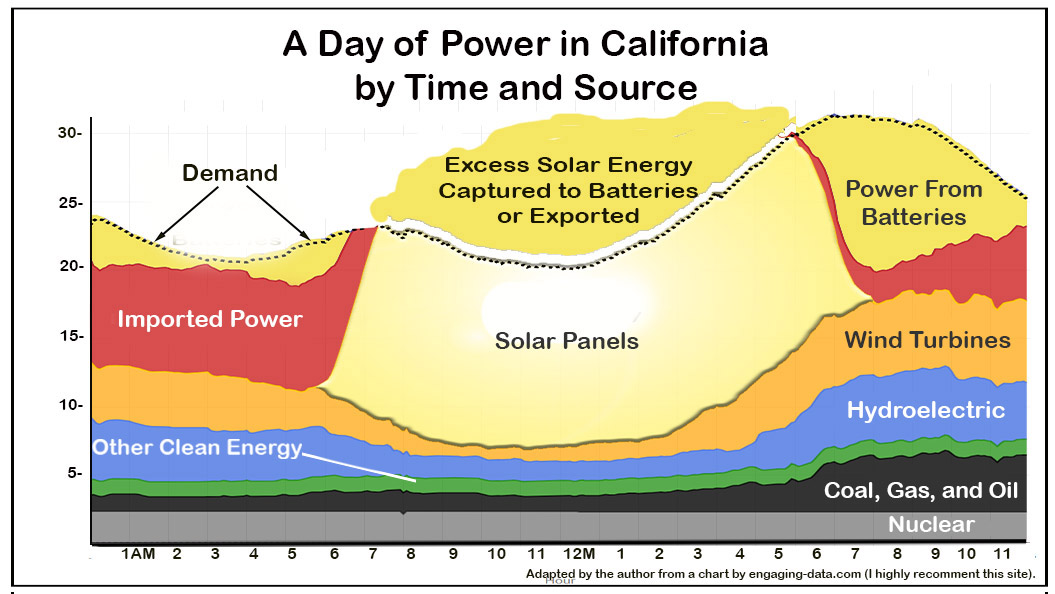
Figure 7: One day of energy use in California in June of 2026. In this image, it is clear that solar dominates the chart. Californians are already on the cusp of using only renewable sources for electricity.