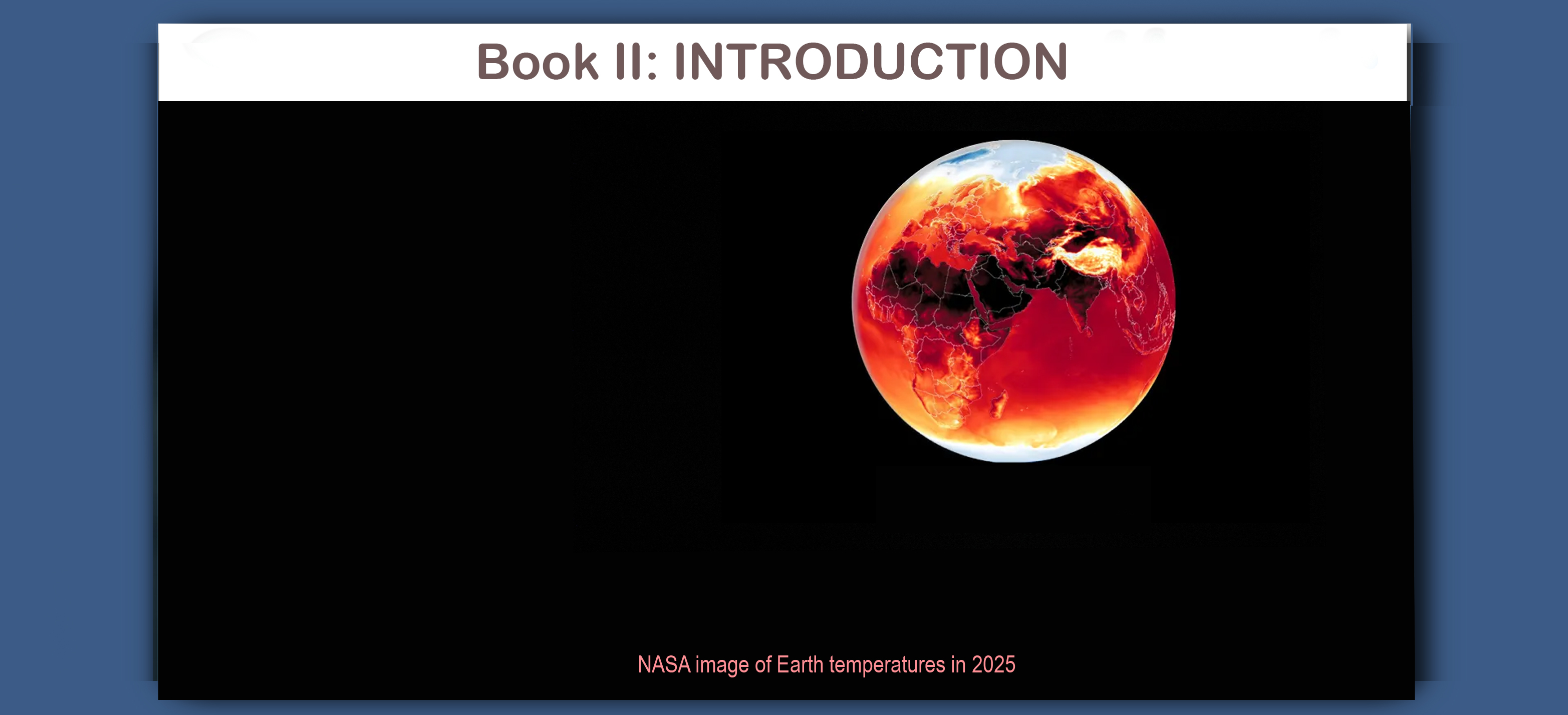
We were first told by NASA that the climate was changing back in 1988.
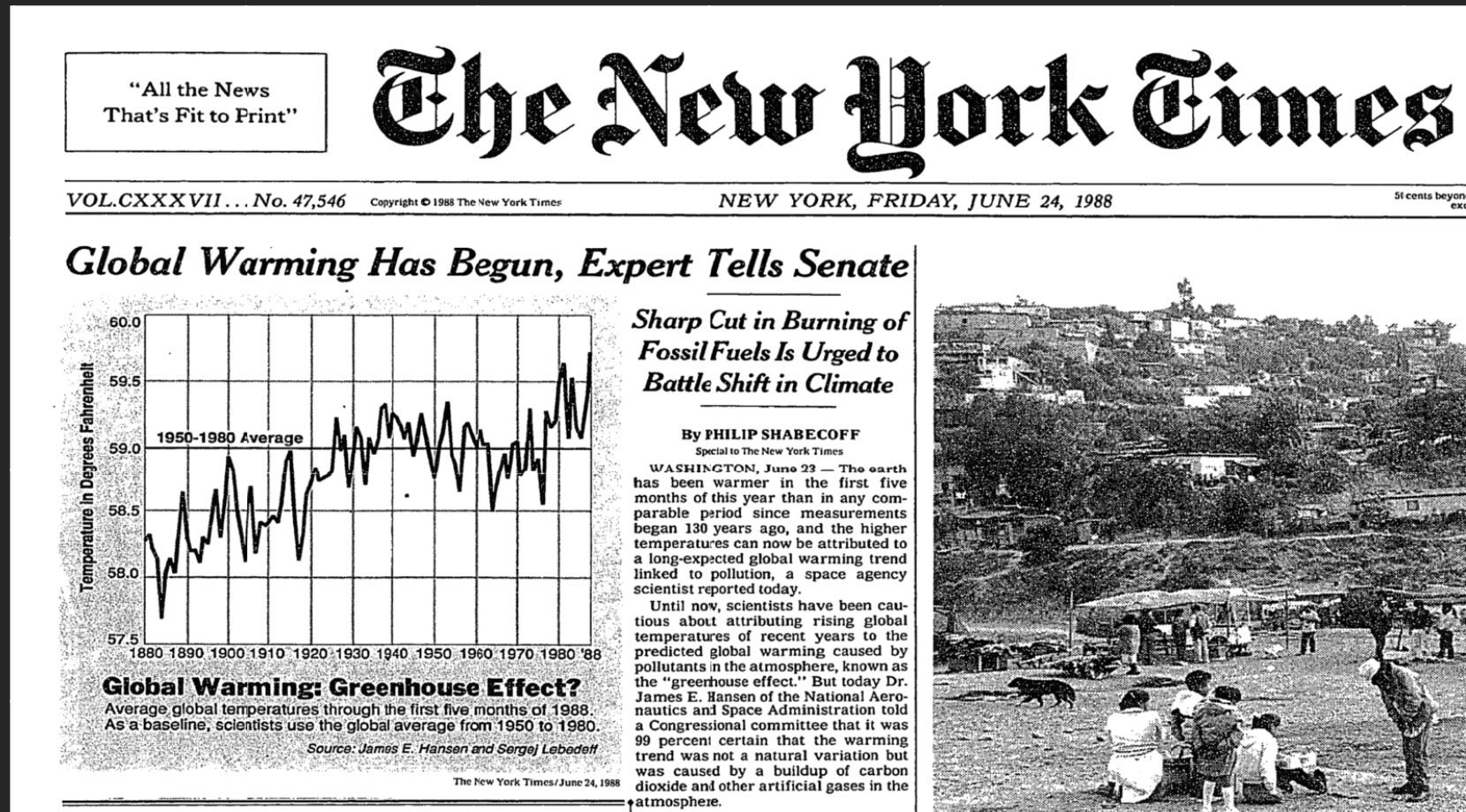
By now, it should be clear that the Earth is heating up. We’ve known this since 1988, when NASA first warned Congress that it was tracking our changing climate from space. James Hansen, then Director of NASA’s Goddard Institute for Space Studies, testified before the U.S. Senate that climate change had begun. His testimony wasn’t speculation, and it wasn’t a warning about some distant future. It was a statement of fact; in 1988, climate change was already underway.
Worse, the petroleum industry had been warned decades earlier. In 1959, at an American Petroleum Institute-sponsored symposium, physicist Dr. Edward Teller explained that if we continued burning fossil fuels, we would increase atmospheric carbon dioxide levels, trigger a greenhouse effect, melt ice, and eventually flood coastal cities. In other words, almost 70 years ago, the petroleum industry was told that its core product would begin destabilizing the climate within 50 years.
Over the next several decades, the industry conducted its own research. Their scientists confirmed Teller’s conclusions and presented this confirmation in papers published in scientific journals and at scientific conferences. Because these journals and conferences are normally unavailable to the American public, we were unaware of these findings until they were made public by the release and publication of petroleum industry documents.
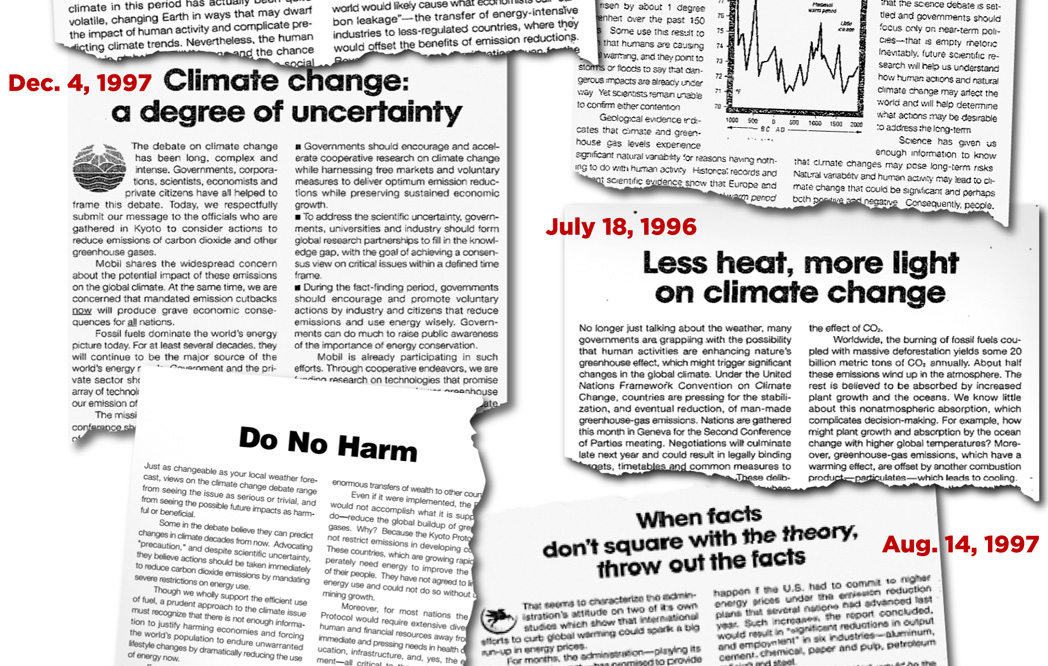
Internal documents were made public by whistleblowers and subpoenas produced when communities began suing the petroleum industry (more on this later). They showed that the corporate executives were fully aware of the results of their studies. Moreover, the internal documents highlighted executive decisions to hide the problem from U.S. citizens and corporate shareholders while the company lobbied Congress in opposition to legislation that might impact their corporate profit margins.
AND while Congress as an institution is not formally “in league” with the petroleum industry, many individual members of the U.S. Government have aligned themselves with industry interests and have worked to obstruct efforts to mitigate climate change. In many cases, their motives are ideological, but in some cases, it’s all just about getting reelected.
So, here we are, seeing the consequences of climate change. The earth is shifting under our feet, and the institutions that should be protecting us, know that climate change is upon us, but suppress the information. For example, the U.S. Presidential Administration, by itself, is making climate change remediation in the United States impossible by issuing executive orders and Cabinet rulings aimed at dismantling climate change mitigation. In the meantime, the House and Senate are gridlocked, with some allying with the President (Trump), some allying with the petroleum industry, some standing on a free market platform, and some doing whatever will give them campaign contributions (or bribes). In fact, in 2025, an ExxonMobil lobbyist named eleven Senators (5 Democrats, 5 Republicans, and one independent) who were working for him, blocking legislation that might help remediate global warming.
We are only now coming to understand what is happening, why it is happening, and what will happen if we don’t stop it.
Most of the time, people hear fragments of information … there’s a wildfire here, there’s a flood there, thousands of people died from the heat in just one day in Europe, a hurricane jumped from stage 1 to stage 5 overnight, or how virtually every year is the hottest on record. On the other hand, we also see a monstrous Polar Vortex sweep through the Midwest and South, or we see twelve-foot snow drifts in Chicago, or 19 people freeze to death in New York. Moreover, we hear conflicting arguments on television – “It’s a Chinese hoax,” “The climate is always changing,” or “97% of Earth Scientists say we could see the end of civilization,” and some even say “we could see the extinction of advanced lifeforms on Earth.” How do all of these contradictions add up?
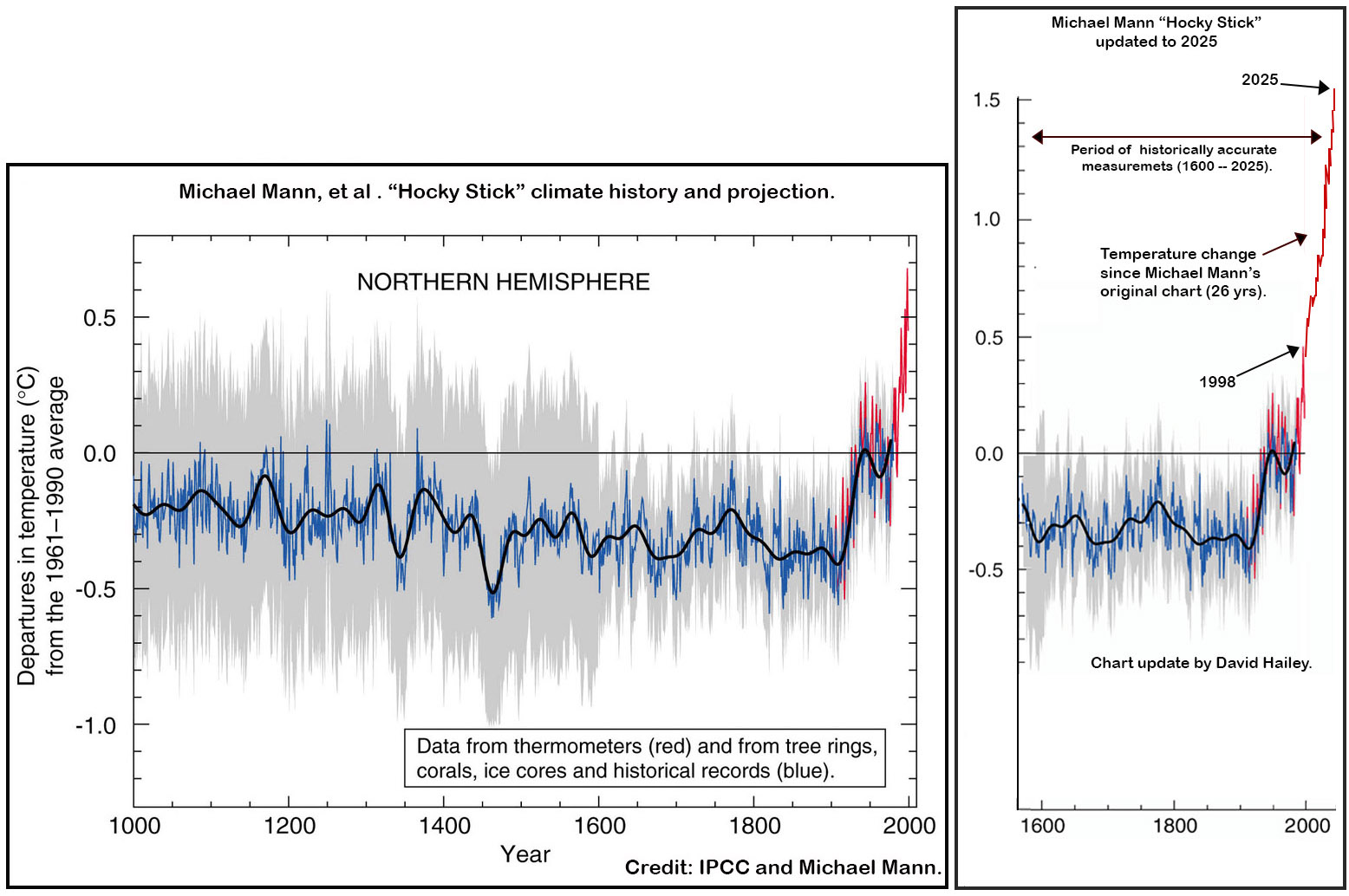
The chart above measures the Earth’s average temperature back the past thousand years. It is nicknamed “the hockey stick” because of its extreme jump on the right compared to the rest of the graph. It ends in 2000, so I took the liberty of bringing it up to date in the second chart. That is what a “climate explosion in geological time” looks like.
So, what does 2.6ºF mean?
It seems like such a small number … 2.6º. The temperature outside will climb 29ºF between 7:00 AM and 5:00 PM today (60º to 88°F), and the night air will be back down to around 60º by morning. That is a swing of 58º in 24 hours. So, even if the Earth is warming, how is 2.6º such a big deal? We know of five mass extinctions, where virtually all life on Earth ended. In every case, the extinctions resulted from changing climate. Even the Chicxulub asteroid, that ended the reign of dinosaurs, did so by creating a year of darkness, followed by a decade of winter.
That, however, is not the real problem. The thermometer has risen by more than 2.6ºF degrees in the past 125 years, but has risen 1.5º in the past 20 years (that is a 100% increase in acceleration). But it is worse, during 2024 and 2025 the average temperature increased by almost half-a-degree in just two years. At this rate, we will blow through 5ºF during the lifetimes of our children.
Two degrees we can live with. Five degrees? … not so much. At this temperature, healthy humans living in South and Central Asia, the Persian Gulf, and much of South America will die of heat exhaustion, even in the shade. Tides will be 10ft higher – Miami, New Orleans, Houston, Norfolk, Corpus Christi, and the barrier islands will all be lost. Fire season lasts all year. The South West U.S. becomes a megadrought region. The Mediterranean region becomes a dust bowl, and monsoons alternate between flood and drought throughout the Midwest. Finally, water cycles (e.g., snow melt) become completely broken.
How are we doing?
That remains to be seen. If you look around a parking lot in front of a supermarket, you will see very few BEVs (battery powered EVs), so from the transportation point of view, we are not doing so great. Worse, our Federal and many of our state governments are actively protecting the fossil fuel industries by discouraging the purchase of EV .
Our infrastructure isn't designed for BEVs.
In the recent past, most of us would have found that in the U.S. a BEV comes with serious problems. More than half of U.S. citizens live in dorms, apartments, townhouses, lofts, rentals, mobile homes, and even vans, all with few charging options. Moreover, unlike most of the world, we sprawl across the landscape. Even people lucky enough to have garages will likely discover no outlets greater than 110VAC. That will give you around four miles per hour of charge. Our electricity system is simply not designed for charging BEVs. For most of us, a hybrid EV (HEV) is the best we can do for now.
Our electric grid is in better shape.
On the other hand, much of our electric grid is way ahead of schedule. It looks like most states’ electric grids will have near-zero carbon footprints by 2035. This is because renewable electricity is significantly less expensive to produce than fossil-fuel powered energy. It costs around half-a-million dollars to build a solar farm, and the fuel to power it is free. In contrast, it costs almost two billion dollars to build a coal-fired plant, and more than a million a week to power it. That coal-fired plant will normally last around 25 years, but we don’t know the lifespan of solar panels. There are panels installed in 1982, still supplying power to the grid in Lugano, Switzerland.
We finally have the tools to end climate change.
The summer of 2024 was the hottest in recorded history. In Central Texas, afternoon temperatures often exceeded 109°F, and every day the citizens were warned that there would be rolling blackouts because the grid could not carry enough power from distant power stations. But the blackouts never happened. A very surprised ERCOT (Texas electric commission) looked into the issue, and discovered that there were so many local household and corporate solar arrays generating power, that they reduced the demand for power from the distant stations.
We are not designed for this.
We live in a 21st-century civilization, but we have ice-age dispositions. For example, our bodies are designed to survive for weeks or months with minimal food during blizzards or droughts, a lifestyle of fasting in lean times and feasting in the fat times. Worse, we are predisposed to eat foods full of sugar and fat. Today, we eat three meals a day like kings and queens and are genetically predisposed to plump right up. Forty percent of the people in the United States are considered medically obese, and forty percent of them have diabetes. Obesity and diabetes are both preventable most of the time, but we are also psychologically predisposed to ignore predictions that contain unhappy futures.
At the same time, we have the instincts we need to store water in case of a potential blackout, but not the instincts to modify our lives so that we protect the lives of our children and their children from futures that are certain to occur without those modifications.
What are we to do about it?
We face an existential threat. The Earth has been warming more and more quickly for decades, and to stop that trend, we must reduce our CO2 emissions and ultimately phase them out. More than a few Americans are doing what they can, but it hasn’t been enough. The ultimate failure means a destabilized civilization (think Mad Max), and in the worst case, our children become an endangered species. But while not enough of the population is engaged, the fossil fuel industry is engaged in blocking climate change remediation.
One might think that, knowing what it knows, the petroleum industry would immediately look for solutions to get us off this path, but that would impact its profits. Instead, the industry has sewn doubt (misinformation, disinformation, and outright lies) to keep us ignorant, divided, and confused. That way, the industry can maintain the status quo until they finally run out of petroleum. Because when we stop burning fossil fuels, they are out of business.
Faced with the existential threat of its own extinction, the oil industry has followed a well-worn path:
- deny the harm,
- undermine the science,
- shift responsibility for any harm to the consumer,
- promote a (fake) “safer” version of the product,
- delay . . . delay . . . delay . . .
Without knowing what the petroleum industry was up to, we have seen it follow every step in these paths for the past 70 years. So, in the late ‘60s and early ‘70s, while we were buying gas-sipping autos because we thought we were running out of petroleum, the oil industry was already planning for the time when we would discover we weren’t just running out of oil, we were also running out of time. And so, now, we have run out of time. We cannot stop what is already here. The best we can do is keep it from getting worse. Together, we can do that. Together we must do that for the sake of our children.
NOTE TO READER: Why would I risk turning away my readers by beginning a book with such devastating news? It’s because we have faced bad news many times before, and we have usually prevailed. We can prevail again, but we have to get onto the right paths. The point of this book is to point to those paths that take us through this climate change crisis safely, while pointing out the other paths that we should avoid. We are currently on one of those paths we should avoid.
The evidence that we can stop damaging our atmosphere and repair the damage we have done is significant and historical.
We have done this before … a dozen or more times. Through the centuries, we have damaged the Earth, often disastrously, but we have also shown that we can repair the damage, and it’s always involved the same pattern: corporations choosing to behave badly no matter what the consequence, with some government officials throwing in with them because of ideology, ego, or greed. Sometimes the government works against our needs, but it usually works for the greater good.
The petroleum industry has convinced most of us that we are the problem -- if only we would quit polluting, the Earth would be fine ("What is your carbon footprint" is a petroleum industry line. As long as we think we are the problem, it will never occur to us that our government is the problem. To repair major damage to our environment usually a population forcing our representatives into action on our behalf. To do this, some of us become proactive, forming committees, protesting, writing letters, voting, and the like, but we can only do what we can do.
One of the parties in our current government has dropped the ball. They have literally blocked all Federal efforts toward mitigating climate change and have, in fact, been disassembling the progress we have made to date. That has happened in the past, however, and we have “voted the rascals out, and pushed the rest into action. By doing that, we have undone much of the damage our corporations have done in the past . . .
- Coal-fired power plants once produced so much acid rain that they were killing forests and fish across the Northeast, but we stopped it and reversed the damage. This required legislating strict limits on sulfur emissions, which coal producers and utilities opposed because compliance meant installing expensive scrubbers and modernizing old plants.
- We poisoned our inner cities with tetraethyl lead in gasoline, poisoning our inner city children, but we stopped those emissions. Removing lead from gasoline faced strong resistance from oil companies and engine manufacturers who argued that unleaded fuel would damage engines and increase costs. We solved the problem by installing catalytic converters in vehicles and replacing lead with ethanol.
- We drove condors, wolves, bison, beavers, Peregrine falcons, and other keystone species to the brink of extinction, but we brought them back. Protecting these species means lost revenue from habitat restrictions and hunting limits, which ranching, logging, and development interests fought for decades.
- We tore a hole in the ozone layer the size of Antarctica, but when we banned the relevant chemicals, the ozone began to heal. Chemical manufacturers initially resisted the ban on CFCs, claiming that alternatives were to costly and that the science was not proven.
- We polluted rivers so badly that some of them caught fire, but we cleaned them, and today the Cuyahoga, Potomac, Hudson, Delaware, Willamette Rivers, and the entire Chesapeake watershed all run clear. Cleaning these waterways required regulating industrial waste and municipal sewage, which many industries opposed because it forced them to install treatment systems and change long-standing disposal practices.
- In some major cities (e.g., LA), the air pollution was so bad that children couldn’t play outside. Today, the skies are largely clear. Automakers resisted catalytic converters and emissions standards, arguing they would make cars too expensive and reduce performance. These catalytic converters are the same ones that made it impossible to burn leaded gasoline (the lead fouled them).
- Lake Erie was declared dead, but we brought phosphorus and wastewater treatment under control, and restored the wetlands, fish populations, water clarity, plus tourism and recreation. Agricultural and industrial groups pushed back against phosphorus limits, claiming fertilizer restrictions and wastewater upgrades would be too costly.
- Moreover, there are more than 1,340 superfund sites, where we have removed toxic materials and replaced them with healthy ones. Cleaning these sites required holding polluters financially responsible, which they resisted, using litigation and lobbying to limit liability.
These were all significant problems with huge health impacts, especially for children, the elderly, and the disadvantaged, but we fixed them. However, we did not fix them through individual efforts. We fixed them by urging our government towards action. And there were enough concerned heroes in our government to undo bad corporate behavior and replace it with better behavior. And once we had acted, the planet repaired itself.
The pattern was always the same:
- Science identifies the problem and notifies us
- We, the public, demand change.
- Government acts to mandate solutions (almost always in spite of industry protestations).
- Industry reluctantly develops better alternatives and implements them.
- The planet heals.
This process worked because we responded as soon as we became aware of a problem. We demanded action, and action followed, because together we were strong, and, imperfect though it is, our government acted in the public interest.
But think about it. In all of this, the corporations were unwilling to change their behavior even if they were driving animals into extinction, making people sick, or even killing children, the elderly, and the poor.
There are always bad actors
It doesn’t take much searching to find a corporation willing to risk or sacrifice human lives to protect its profit margin (e.g., Volkswagen’s rear seat belt failures, Ford’s exploding fuel tanks). Some companies have killed and injured people by the thousands (e.g., Ethyl did with leaded gas). And some have knowingly killed people by the millions, as Phillip Morris still does with tobacco and Exxon is doing it with petroleum. Corporations seldom change their behavior voluntarily; they change only when government mandates force them to change.
What our path might look like
There are many things we can do as individuals, and they all matter. But without political action, without governments setting standards and industries building the alternatives, we simply cannot change the trajectory of climate change. The scale is too large for personal choices to make a meaningful difference. In short, we have to do what we can, but we need to make our governments and corporations do their parts.
We were once on clear and effective paths toward climate change remediation. For decades, Congress, the Senate, and the Executive Branch have worked together to solve environmental crises (e.g., acid rain, polluted rivers, climate change). But in recent years, that unity has fractured. Many elected officials now oppose or delay climate action for a variety of reasons:
- Some prioritize free market principles.
- Some believe climate risks are overstated by scientists.
- Some believe that hasty action would harm the economy.
- Some are afraid of possible political repercussions.
- And some just do it for the money.
Whatever the reason, the result is the same: in our political system, too few are aligned around meeting the public need. As a result, in MAGA circles, the very mention of climate change is forbidden.
We need to be smart.
I once test-drove a used Polestar EV that had fewer than 500 miles on it. These opportunities to buy brand-new used EVs are not particularly rare. People will often buy without knowing how they will take care of it, and suddenly discover there is no way they can conveniently keep it charged. If you can reasonably own an EV, you should have one, but only around half of Americans are in a position to reasonably own one.
Suppose you rush out and spend $105K for an EV. It’s expensive, and unless you charge from a clean grid, the vehicle inherits the carbon intensity of that grid, which in places like West Virginia is still dominated by coal.
But imagine a different approach: instead of replacing 280 million vehicles, the government mandates a transition to renewable liquid fuels (fuels produced with plant matter with a carbon footprint comparable to an EV’s.) The mandate might begin with 25% renewable gasoline available by 2030 and ramp up to 90% renewable gasoline by 2075. Then, you don’t have to buy a new car. All need to do is fill up with the cleaner fuel. This allows us to reduce emissions dramatically by changing the fuel, not vehicles. But we can’t do this independently; it takes a government mandate.
We’re not powerless, but our power comes from our unity: our communities, our votes. our voices, and our demands, but the heavy lifting must be done by Congress, the White House, and industry. But there are those in the White House and Congress who find it more profitable to obstruct climate change remediation, and the oil industry has successfully protected its petroleum profits for the past 40 years.