FRONT MATTER
By Dr. David E. Hailey
Published by Interactive Media Research Laboratory as a book-length hypertext.
Copyright David E. Hailey, July 4, 2026.
This is an organic book focused on a constantly changing subject and will change as conditions change.
All content by the author is available for use by others with appropriate attribution.
Content by others and used by the author is available to the extent allowed by the original creator.
This book is entirely non-profit, used for informational and instructional purposes and claims fair use protection for the use of images or charts on public display. However, if any original creator objects to the use of an image, notify us, and it will be immediately removed.
At 83, I’m an old guy, long past my “use by” date. But I’ve been dealing with sustainability questions for my entire adult life. I began writing about it professionally in 1983, when I worked as a technical communicator for heavy industry publications. At the time, we were looking for paths that lead to reducing the industry's consumption of irreplaceable minerals. Believe it or not, heavy industry has been working out how to recycle construction materials since the 1960s.
In 1990, I received my master’s degree in nonfiction, and in 1994 my Ph.D. in critical theory. Finally, in 2022 and 2023, I studied toward a Post-Graduate Professional Certification in Sustainability at the Massachusetts Institute of Technology. At the end of that year of study, I became an MIT Certified Sustainability Science Writer.
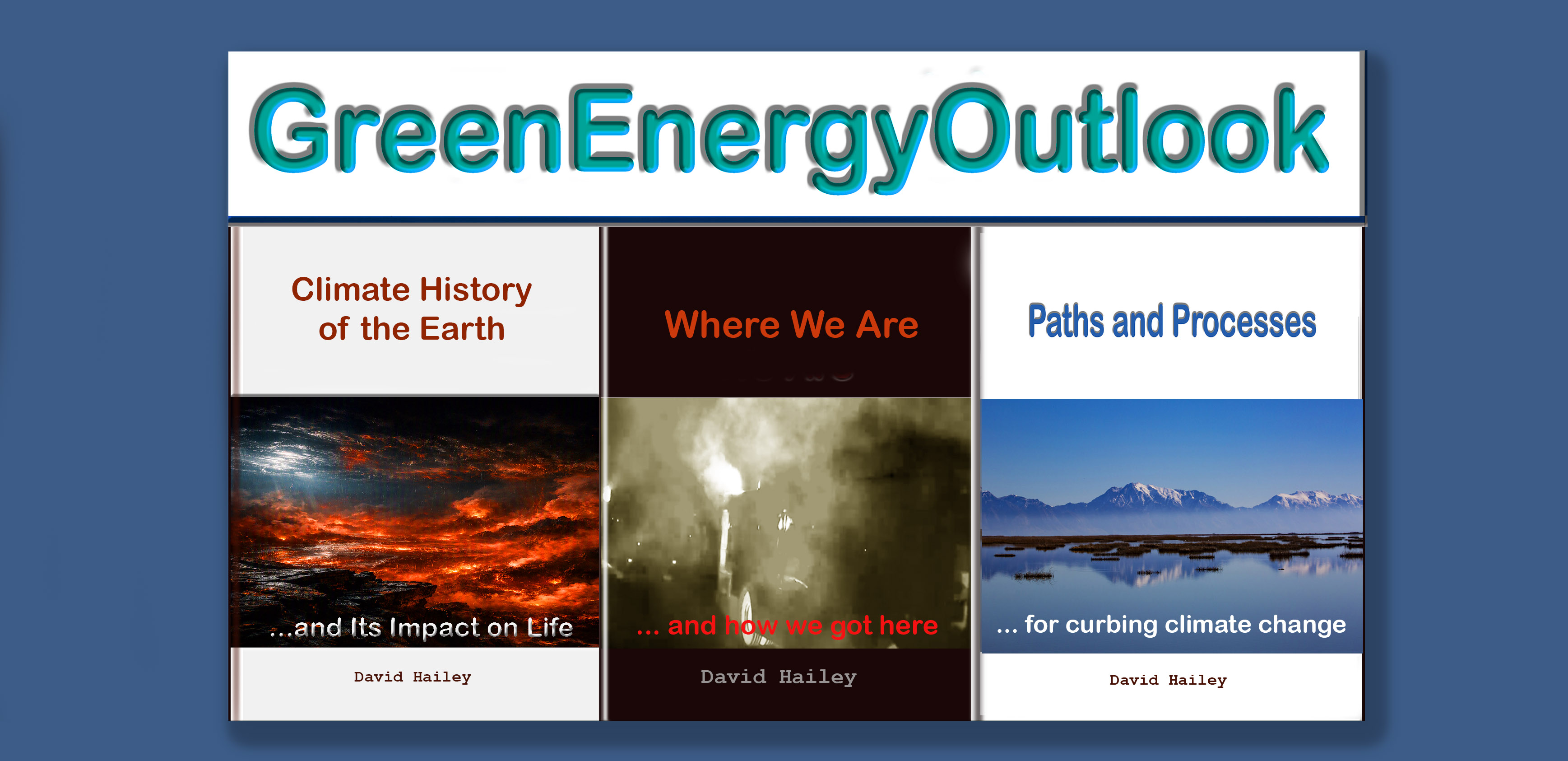
MY PUBLICATIONS
In brief, I write about technology and science, with a specific interest in sustainability. We technology writers do a particular kind of work: we stand between scientists and engineers on one side and the public on the other, and we translate complex ideas for the general public. We make complex systems understandable. That’s what I’m doing here. I’m not the scientist inventing the breakthroughs that will save humanity; I’m the person watching that scientist work, asking questions, and reporting the results to you ... giving you the chance to see which of those ideas might fit into your own lifestyle.
This is dedicated to my wife, Chris, who stood with me through more than 20 years of my mood swings while I stared into the face of impending climate change.
Why did I write this?
If I were to ask you whether you thought a book about climate change is a good idea, I expect that you would say, “Of course!” “But,” you might ask. “Why a website? Who on earth would ever read a book-length website?”
Of course, I can think of nobody who would read a book-length website. My readers (my audience) will be looking for the answers to the question, “What can I do?” and the point of this book is to answer those questions. Unfortunately, the answer to those questions are different for each of us. We are each following different paths, and we will each pick a different path into a sustainable future. This book embraces that truth and explores and describes a huge variety of paths.
Moreover, there is nothing stationary about climate change. Conditions, paths, and processes are in a constant state of change, and a book dealing with these topics must, necessarily change with them. Only hypertexts are able to quickly make changes over time, and only a hypermedia book is sufficiently expansive to handle the complexities of simulations, animations, and real-time communication. And that brings us to the World Wide Web, the only place capable of hosting such a book and making it publicly available to everyone. And if you cannot find your answer here, there is a blog where you can ask questions and get answers from a group of researchers. MORE
As an independent science writer, I work without the institutional support typically necessary for complex nonfiction projects. I have no research assistants, no subject matter experts, no in house editors, and no fact checking department. To compensate, I rely on Microsoft Copilot as a multi role colleague throughout the development of this book.
More specifically, I used Copilot in five distinct ways:
1. Concept Development and Brainstorming I use Copilot as a thinking partner to explore large, interdisciplinary ideas such as climate systems, evolutionary psychology, energy transitions, and communication theory.
2. Resource Identification Copilot assists in locating relevant scientific literature, historical sources, technical documentation, and policy references. This allows me to quickly expand the scope of my research beyond what a single writer could gather alone within a reasonable timeline.
3. Fact Checking and Verification Every claim in this book is subjected to a fact checking pass using Copilot’s search and synthesis capabilities. This includes verifying scientific statements, historical timelines, policy details, and technical descriptions.
4. Copyediting and Proofreading Copilot provides line level editing, clarity improvements, structural suggestions, and consistency checks. It functiones as a combined copyeditor and proofreader, helping refine the prose to publication quality.
Help with improving code Although I can design and code using HTML, CSS, and JS, it is helpful to have Copilot look at my code with an eye toward suggesting smoother and more elegant coding. Moreover, I do not always know the exact code. Many times, I began a sentence to Copilot with, "In HTML, how do I ..."
In the end, AI becomes as much a proofreader, spellchecker, copyeditor, and fact checker for my code as for my copy.
Although I often read comments from writers saying they would never use an AI bot for any purpose, I have found that using AI helps me with my research and for monitoring the quality of my writing to be immensely helpful
In short, I believe that writers who learn how to use AI effectively in their writing, will be poised to enter the next generation of publication with stronger communication skills. I believe that writers who deride the use of AI as cheating, can be compared to monks deriding people who worked with printing presses as “printer’s devils.
CLIMATE HISTORY OF THE EARTH
Before expressing opinions about the controversial topic of climate change, it is reasonable that we should know something about climate change.
For example, that I am able to be writing this, has little to with the skill or intellect of our ancestors, and a great deal to do with their luck. As concerns the history of life on this Earth, we are among the 0.01% of the species that survived. That is to say that of all species that have ever lived on Earth, 99.9% of them are extinct. The only possible conclusion we can draw is that is this: “the Earth is not a safe place.”
This is an organic book focused on a constantly changing subject and will change as conditions change.
All content by the author is available for use by others with appropriate attribution.
Content by others and used by the author is available to the extent allowed by the original creator.
This book is entirely non-profit, used for informational and instructional purposes and claims fair use protection for the use of images or charts on public display. However, if any original creator objects to the use of an image, notify us, and it will be immediately removed.
At 83, I’m an old guy, long past my “use by” date. But I’ve been dealing with sustainability questions for my entire adult life. I began writing about it professionally in 1983, when I worked as a technical communicator for heavy industry publications. At the time, we were looking for paths that lead to reducing the industry's consumption of irreplaceable minerals. Believe it or not, heavy industry has been working out how to recycle construction materials since the 1960s.
In 1990, I received my master’s degree in nonfiction, and in 1994 my Ph.D. in critical theory. Finally, in 2022 and 2023, I studied toward a Post-Graduate Professional Certification in Sustainability at the Massachusetts Institute of Technology. At the end of that year of study, I became an MIT Certified Sustainability Science Writer.
MY PUBLICATIONS
In brief, I write about technology and science, with a specific interest in sustainability. We technology writers do a particular kind of work: we stand between scientists and engineers on one side and the public on the other, and we translate complex ideas for the general public. We make complex systems understandable. That’s what I’m doing here. I’m not the scientist inventing the breakthroughs that will save humanity; I’m the person watching that scientist work, asking questions, and reporting the results to you ... giving you the chance to see which of those ideas might fit into your own lifestyle.
WHERE WE ARE
By Dr. David E. Hailey
Published by Interactive Media Research Laboratory as a book-length hypertext.
Copyright David E. Hailey, July 4, 2026.
This is an organic book focused on a constantly changing subject and will change as conditions change.
All content by the author is available for use by others with appropriate attribution.
Content by others and used by the author is available to the extent allowed by the original creator.
This book is entirely non-profit, used for informational and instructional purposes and claims fair use protection for the use of images or charts on public display. However, if any original creator objects to the use of an image, notify us, and it will be immediately removed.
At 83, I’m an old guy, long past my “use by” date. But I’ve been dealing with sustainability questions for my entire adult life. I began writing about it professionally in 1983, when I worked as a technical communicator for heavy industry publications. At the time, we were looking for paths that lead to reducing the industry's consumption of irreplaceable minerals. Believe it or not, heavy industry has been working out how to recycle construction materials since the 1960s.
In 1990, I received my master’s degree in nonfiction, and in 1994 my Ph.D. in critical theory. Finally, in 2022 and 2023, I studied toward a Post-Graduate Professional Certification in Sustainability at the Massachusetts Institute of Technology. At the end of that year of study, I became an MIT Certified Sustainability Science Writer.
MY PUBLICATIONS
In brief, I write about technology and science, with a specific interest in sustainability. We technology writers do a particular kind of work: we stand between scientists and engineers on one side and the public on the other, and we translate complex ideas for the general public. We make complex systems understandable. That’s what I’m doing here. I’m not the scientist inventing the breakthroughs that will save humanity; I’m the person watching that scientist work, asking questions, and reporting the results to you ... giving you the chance to see which of those ideas might fit into your own lifestyle.
This is dedicated to my wife, Chris, who stood with me through more than 20 years of my mood swings while I stared into the face of impending climate change.
Why did I write this?
If I were to ask you whether you thought a book about climate change is a good idea, I expect that you would say, “Of course!” “But,” you might ask. “Why a website? Who on earth would ever read a book-length website?”
Of course, I can think of nobody who would read a book-length website. My readers (my audience) will be looking for the answers to the question, “What can I do?” and the point of this book is to answer those questions. Unfortunately, the answer to those questions are different for each of us. We are each following different paths, and we will each pick a different path into a sustainable future. This book embraces that truth and explores and describes a huge variety of paths.
Moreover, there is nothing stationary about climate change. Conditions, paths, and processes are in a constant state of change, and a book dealing with these topics must, necessarily change with them. Only hypertexts are able to quickly make changes over time, and only a hypermedia book is sufficiently expansive to handle the complexities of simulations, animations, and real-time communication. And that brings us to the World Wide Web, the only place capable of hosting such a book and making it publicly available to everyone. And if you cannot find your answer here, there is a blog where you can ask questions and get answers from a group of researchers. MORE
As an independent science writer, I work without the institutional support typically necessary for complex nonfiction projects. I have no research assistants, no subject matter experts, no in house editors, and no fact checking department. To compensate, I rely on Microsoft Copilot as a multi role colleague throughout the development of this book.
More specifically, I used Copilot in five distinct ways:
1. Concept Development and Brainstorming I use Copilot as a thinking partner to explore large, interdisciplinary ideas such as climate systems, evolutionary psychology, energy transitions, and communication theory.
2. Resource Identification Copilot assists in locating relevant scientific literature, historical sources, technical documentation, and policy references. This allows me to quickly expand the scope of my research beyond what a single writer could gather alone within a reasonable timeline.
3. Fact Checking and Verification Every claim in this book is subjected to a fact checking pass using Copilot’s search and synthesis capabilities. This includes verifying scientific statements, historical timelines, policy details, and technical descriptions.
4. Copyediting and Proofreading Copilot provides line level editing, clarity improvements, structural suggestions, and consistency checks. It functiones as a combined copyeditor and proofreader, helping refine the prose to publication quality.
Help with improving code Although I can design and code using HTML, CSS, and JS, it is helpful to have Copilot look at my code with an eye toward suggesting smoother and more elegant coding. Moreover, I do not always know the exact code. Many times, I began a sentence to Copilot with, "In HTML, how do I ..."
In the end, AI becomes as much a proofreader, spellchecker, copyeditor, and fact checker for my code as for my copy.
Although I often read comments from writers saying they would never use an AI bot for any purpose, I have found that using AI helps me with my research and for monitoring the quality of my writing to be immensely helpful
In short, I believe that writers who learn how to use AI effectively in their writing, will be poised to enter the next generation of publication with stronger communication skills. I believe that writers who deride the use of AI as cheating, can be compared to monks deriding people who worked with printing presses as “printer’s devils.
PATHS AND PROCESSES
By Dr. David E. Hailey
Published by Interactive Media Research Laboratory as a book-length hypertext.
Copyright David E. Hailey, July 4, 2026.
This is an organic book focused on a constantly changing subject and will change as conditions change.
All content by the author is available for use by others with appropriate attribution.
Content by others and used by the author is available to the extent allowed by the original creator.
This book is entirely non-profit, used for informational and instructional purposes and claims fair use protection for the use of images or charts on public display. However, if any original creator objects to the use of an image, notify us, and it will be immediately removed.
At 83, I’m an old guy, long past my “use by” date. But I’ve been dealing with sustainability questions for my entire adult life. I began writing about it professionally in 1983, when I worked as a technical communicator for heavy industry publications. At the time, we were looking for paths that lead to reducing the industry's consumption of irreplaceable minerals. Believe it or not, heavy industry has been working out how to recycle construction materials since the 1960s.
In 1990, I received my master’s degree in nonfiction, and in 1994 my Ph.D. in critical theory. Finally, in 2022 and 2023, I studied toward a Post-Graduate Professional Certification in Sustainability at the Massachusetts Institute of Technology. At the end of that year of study, I became an MIT Certified Sustainability Science Writer.
MY PUBLICATIONS
In brief, I write about technology and science, with a specific interest in sustainability. We technology writers do a particular kind of work: we stand between scientists and engineers on one side and the public on the other, and we translate complex ideas for the general public. We make complex systems understandable. That’s what I’m doing here. I’m not the scientist inventing the breakthroughs that will save humanity; I’m the person watching that scientist work, asking questions, and reporting the results to you ... giving you the chance to see which of those ideas might fit into your own lifestyle.
This is dedicated to my wife, Chris, who stood with me through more than 20 years of my mood swings while I stared into the face of impending climate change.
Why did I write this?
If I were to ask you whether you thought a book about climate change is a good idea, I expect that you would say, “Of course!” “But,” you might ask. “Why a website? Who on earth would ever read a book-length website?”
Of course, I can think of nobody who would read a book-length website. My readers (my audience) will be looking for the answers to the question, “What can I do?” and the point of this book is to answer those questions. Unfortunately, the answer to those questions are different for each of us. We are each following different paths, and we will each pick a different path into a sustainable future. This book embraces that truth and explores and describes a huge variety of paths.
Moreover, there is nothing stationary about climate change. Conditions, paths, and processes are in a constant state of change, and a book dealing with these topics must, necessarily change with them. Only hypertexts are able to quickly make changes over time, and only a hypermedia book is sufficiently expansive to handle the complexities of simulations, animations, and real-time communication. And that brings us to the World Wide Web, the only place capable of hosting such a book and making it publicly available to everyone. And if you cannot find your answer here, there is a blog where you can ask questions and get answers from a group of researchers. MORE
As an independent science writer, I work without the institutional support typically necessary for complex nonfiction projects. I have no research assistants, no subject matter experts, no in house editors, and no fact checking department. To compensate, I rely on Microsoft Copilot as a multi role colleague throughout the development of this book.
More specifically, I used Copilot in five distinct ways:
1. Concept Development and Brainstorming I use Copilot as a thinking partner to explore large, interdisciplinary ideas such as climate systems, evolutionary psychology, energy transitions, and communication theory.
2. Resource Identification Copilot assists in locating relevant scientific literature, historical sources, technical documentation, and policy references. This allows me to quickly expand the scope of my research beyond what a single writer could gather alone within a reasonable timeline.
3. Fact Checking and Verification Every claim in this book is subjected to a fact checking pass using Copilot’s search and synthesis capabilities. This includes verifying scientific statements, historical timelines, policy details, and technical descriptions.
4. Copyediting and Proofreading Copilot provides line level editing, clarity improvements, structural suggestions, and consistency checks. It functiones as a combined copyeditor and proofreader, helping refine the prose to publication quality.
Help with improving code Although I can design and code using HTML, CSS, and JS, it is helpful to have Copilot look at my code with an eye toward suggesting smoother and more elegant coding. Moreover, I do not always know the exact code. Many times, I began a sentence to Copilot with, "In HTML, how do I ..."
In the end, AI becomes as much a proofreader, spellchecker, copyeditor, and fact checker for my code as for my copy.
Although I often read comments from writers saying they would never use an AI bot for any purpose, I have found that using AI helps me with my research and for monitoring the quality of my writing to be immensely helpful
In short, I believe that writers who learn how to use AI effectively in their writing, will be poised to enter the next generation of publication with stronger communication skills. I believe that writers who deride the use of AI as cheating, can be compared to monks deriding people who worked with printing presses as “printer’s devils.